Monthly Archives: March 2026
Inside the Underground Vinyl Swap That’s Rewiring Music Discovery
The Secret Language of Crate Diggers
Every second Saturday at 2 PM, a dozen people gather in the back room of Meridian Coffee on Elm Street. No signs point the way. No social media announcements trumpet the event. You find out through whispered recommendations or by catching sight of someone lugging a milk crate of records through the coffee shop’s front door.
This is the Monthly Spin Exchange, and it has rules that would make the most exclusive speakeasy seem welcoming by comparison. First rule: bring something rare, something personal, something that tells a story. Second rule: no phones during the actual trading. Third rule: every record that changes hands comes with a story about how the previous owner found it.
Marcus Chen, a software engineer who started the group three years ago, explains the philosophy while sorting through a crate of Japanese pressings. “Streaming algorithms know what you’ve listened to, but they don’t know why you cried during that Radiohead track at 3 AM or how finding an original pressing of ‘Pet Sounds’ felt like discovering buried treasure.” The vinyl swap exists to preserve those why stories. It creates connections that beat the cold efficiency of digital discovery.
The group includes Sarah Martinez, a nurse who focuses on rare soul records from the 1960s, and David Kim, a retired teacher whose collection spans everything from Mongolian throat singing to experimental noise rock. What unites them isn’t genre loyalty but a shared belief that music discovery should be communal, surprising, and deeply personal.

Trading Stories, Not Just Vinyl
Watch the group in action and you’ll notice something unusual. Before any record changes hands, there’s a ritual. The current owner shares not just the album’s details but the story of how they got it. Where they found it, why they bought it, what it meant during a particular period of their life. Only then does the trading begin.
Last month, Sarah brought a scratched copy of Ann Peebles’ “I Can’t Stand the Rain” that she’d rescued from a garage sale in Memphis during her nursing school years. “The woman selling it said it belonged to her grandmother who used to sing along while cooking Sunday dinner,” Sarah told the group. “That scratch on track three? Her granddaughter made it when she was learning to use the turntable at age six.”
The album went to Jamie Rodriguez, a local musician who’d been hunting for that exact pressing for two years. In return, Jamie offered a pristine copy of Joni Mitchell’s “Blue” still in its original shrink wrap. “Found this in a storage unit I bought at auction,” Jamie explained. “Previous owner had five copies, all unopened. Felt like keeping them sealed was doing the music a disservice.”
These aren’t transactions in any traditional sense. They’re cultural exchanges where context and history matter as much as sound quality. The group has developed a detailed understanding of each member’s tastes, creating matches that often surprise even the participants themselves.
Beyond the Algorithm
The Monthly Spin Exchange is something bigger than record collecting. In an era when music discovery happens through recommendation engines and social media influence, these gatherings offer human curation at its most intimate. The suggestions come loaded with personal stakes and emotional investment.
Marcus keeps a notebook tracking not just the albums traded but the connections formed. “Danny introduced Helen to Brazilian tropicália last spring, and now she’s learning Portuguese to better understand the lyrics. Tom’s jazz recommendations helped Sarah through a difficult breakup. These ripple effects happen because real humans are making these connections.”
The group has accidentally become a testing ground for how community forms around shared passions in the digital age. Members have started bands together, attended concerts as a group, and even organized listening parties for particularly significant releases. The vinyl trades sparked something deeper: a network of people genuinely invested in each other’s musical journeys.
Emma Thompson, who joined six months ago, describes the difference between algorithm-driven discovery and human recommendation. “Spotify might suggest something based on my listening patterns, but Marcus recommended Arthur Russell because he knew I was going through a creative block and thought the experimental approach might unlock something. He was right. That’s the difference between data analysis and actual understanding.”
The Ripple Effect
What started as a dozen people trading vinyl has turned into something like a small cultural institution. The group’s influence extends beyond their monthly meetings. Local record stores now ask members for input on special orders. The nearby venue The Basement started a monthly listening series based on albums discovered through the swap.
The exchange has also become a proving ground for local musicians. Members regularly bring demos and limited releases from area artists, creating a feedback loop that supports the broader music community. Last year’s breakout local act, Velvet Machinery, first gained traction when their demo circulated through the swap network.
But perhaps most importantly, the group has started documenting their activities through oral history projects. They record the stories behind particularly meaningful trades, creating an archive that captures not just what music changed hands but why it mattered. These recordings have caught the attention of ethnomusicologists studying how musical communities form and sustain themselves.
The Monthly Spin Exchange proves that even in our hyper-connected world, there’s hunger for the unpredictable magic of human recommendation. In a back room above a coffee shop, a dozen music lovers are quietly changing how discovery happens, one story-heavy album at a time.
If you’ve got records collecting dust and stories worth sharing, Marcus says newcomers are always welcome. Just remember the rules, bring something meaningful, and prepare to leave with music that might change how you hear the world. The next meeting is this Saturday at 2 PM. Look for the milk crates.
Why Every New Taco Shop Has the Same Ghost Kitchen Problem
The Six-Month Mark
Walked past the corner of Maple and Third yesterday where that buzzy Korean-Mexican fusion place used to be. You know, the one with the purple neon and the Instagram wall that lasted exactly seven months. Now there’s a hand-painted sign in the window: “Coming Soon: Nonna’s Authentic Italian.” Same layout, same kitchen, probably the same grease trap issues that killed the last three concepts in this spot.
This isn’t just about one cursed corner. Across the neighborhood, restaurant turnover has hit a weird rhythm. Places open with massive fanfare, burn bright for exactly one season, then disappear into permit limbo. The pattern is so predictable that Maria at the corner bodega started a betting pool on how long each new spot will last.
The Ghost Kitchen Invasion
Here’s what’s actually happening behind all those “Coming Soon” signs. Three blocks over, inside what used to be Tony’s Pizza, there’s now something called CloudKitchen Express. No seating, no signs, just five different restaurant concepts operating out of the same kitchen. Burger Palace, Wing Dynasty, Healthy Bowls Co, Taco Libre, and Thai Garden all share the same address and the same industrial freezer.
The delivery drivers know the deal. They pull up to a blank storefront and text a number. Someone brings out bags with five different logos, all containing food that tastes suspiciously similar. It’s efficient, sure, but it’s also killing the ecosystem that made places like Chen’s Dumplings and The Blue Door Café actual neighborhood institutions for twenty years.
The economics are brutal. Real restaurants need six months minimum to build a customer base, but landlords want immediate returns and delivery platforms take thirty percent off the top. Ghost kitchens can pivot concepts in two weeks and test new markets without the overhead of actual hospitality.
The Survival Stories
Some places are cracking the code, though. Rosita’s Pupusas survived by basically ignoring every food trend of the past three years. Same menu since 2019, same red vinyl booths, same hand-written specials board that Rosita updates with a Sharpie every Tuesday. Her secret weapon isn’t social media or third-party delivery apps. It’s knowing that Mrs. Patterson needs her pupusas extra crispy and that the high school kids will pay extra for larger portions on Fridays.
Then there’s The Greenhouse, which opened right as the ghost kitchen trend peaked. Instead of competing with delivery-only concepts, owner Jamie Chen doubled down on being undeniably physical. Live music Wednesdays, community board meetings Sundays, and a pay-what-you-can soup night that’s become this accidental neighborhood institution. You can’t ghost kitchen your way into hosting the monthly tenants’ rights meeting.
The Landlord Factor
What nobody talks about is how much the landlord lottery determines who survives. The building owner at 847 Central Avenue has kept the same Thai family in their space for twelve years, never raising rent above market rate because Som’s Green Curry brings foot traffic to the whole block. Two streets over, a different landlord cycles through tenants every eighteen months, jacking up rent the moment a concept shows promise.
The newest casualty was Midnight Provisions, that natural wine bar that felt like drinking in someone’s living room. They lasted eleven months, long enough to train a generation of locals on orange wine and small plates. But when renewal time came, rent jumped forty percent. The space sits empty now because the landlord is holding out for a national chain.
This isn’t some abstract market force. It’s Steve Chen (no relation to Jamie) who owns six buildings on this strip and seems determined to turn every storefront into a Subway or a Starbucks. His buildings have the highest turnover rate in the neighborhood, but also the highest asking rents.
What Comes After the Churn
The restaurant scene that’s emerging looks nothing like what we had five years ago. The middle ground is disappearing. You get either ghost kitchens optimized for delivery algorithms or deeply rooted places that have become community centers as much as restaurants. Everything in between gets chewed up by rent increases and platform fees.
The interesting development is how some former restaurant workers are pivoting. Marcus, who used to run the kitchen at that failed fusion place, now runs a weekly pop-up in the back room of Borrowed Time Books. Lower overhead, built-in community, no delivery app middlemen. He’s selling more food per week than most brick-and-mortar spots, and people actually know his name.
Maybe that’s the future. Not ghost kitchens that erase personality, but hyper-local concepts that embed themselves so deeply in neighborhood fabric that they become impossible to extract. The question is whether enough landlords and customers will choose personality over efficiency, community over convenience. The betting pool at the bodega is still taking odds.
The Independent Bookstore Renaissance That Almost Wasn’t
The Death Spiral Years: 2007-2012
Remember when everyone said indie bookstores were dead? Like, actually dead dead. Not “struggling” or “finding their footing” but full-on funeral planning dead. The American Booksellers Association tracked it in real time: 4,000 independent bookstores in the early 2000s plummeting to just 1,651 by 2009. Borders collapsed. Barnes & Noble was hemorrhaging stores. Amazon was the villain in every think piece.
I watched three bookstores close on my block alone between 2008 and 2011. First went Cornerstone Books, then that weird little sci-fi place with the cat, then the used bookstore where you could trade paperbacks for coffee. The owners all said the same thing: rent’s too high, margins too thin, can’t compete with online prices. The writing wasn’t just on the wall. It was spray-painted in neon.
But here’s what everyone missed while they were writing obituaries. The survivors weren’t just hanging on. They were changing. Fast.

The Turning Point: 2013-2016
The turnaround started quietly. Small shifts that looked like desperation moves but were actually smart adaptations. BookCourt in Brooklyn started hosting three events per week instead of one per month. Housing Works began curating their used book selection like a boutique. The Strand doubled down on their branded merchandise and started that infamous book subscription service.
Then 2013 hit, and something clicked. The ABA membership numbers stopped falling. Actually stopped. For the first time in a decade, the decline plateaued. Not growth yet, but not the death spiral either. Store owners I talked to back then described it like this: customers were coming back, but they wanted something different. Not just books. An experience.
The smart operators figured it out first. Politics & Prose in DC transformed their event space into a proper venue. Elliott Bay Book Company in Seattle started serving wine at readings. Skylight Books in LA began selling vinyl records alongside poetry collections. They weren’t competing with Amazon anymore. They were competing with Netflix and Instagram and whatever else was keeping people home.
By 2015, the ABA reported the first membership increase in years. Tiny, but real. The indie bookstore wasn’t just surviving. It was becoming something new.
The Instagram Effect: 2017-2020
Then social media changed everything. Not because bookstores started posting on Instagram, but because reading became photogenic again. Book clubs exploded. #Bookstagram took off. Being seen with the right book became a flex. Suddenly, buying books at an indie store wasn’t just about supporting local business. It was about curating your aesthetic.
The savvy stores leaned in hard. Dog Eared Books in San Francisco redesigned their window displays for maximum shareability. Book Larder in Seattle started selling gorgeous cookbooks that looked incredible on feeds. Rizzoli Bookstore in New York basically became a tourist destination based on their Instagram presence alone.
The numbers backed up what I was seeing in real time. The ABA membership grew to over 2,500 stores by 2019. New stores were opening faster than old ones were closing. Not just surviving stores either. Ambitious new concepts like The Wild Detectives in Dallas, combining bookstore with bar, or Literati Bookstore in Ann Arbor, which literally branded their own beer.
COVID should have killed the momentum. Instead, it sped things up. While big box stores fumbled their online presence, indie bookstores pivoted to curbside pickup, virtual events, and hyper-local delivery. Customers who discovered their neighborhood bookstore during lockdown kept coming back when things reopened. The relationship stuck.
The Current Scene: What Actually Survived
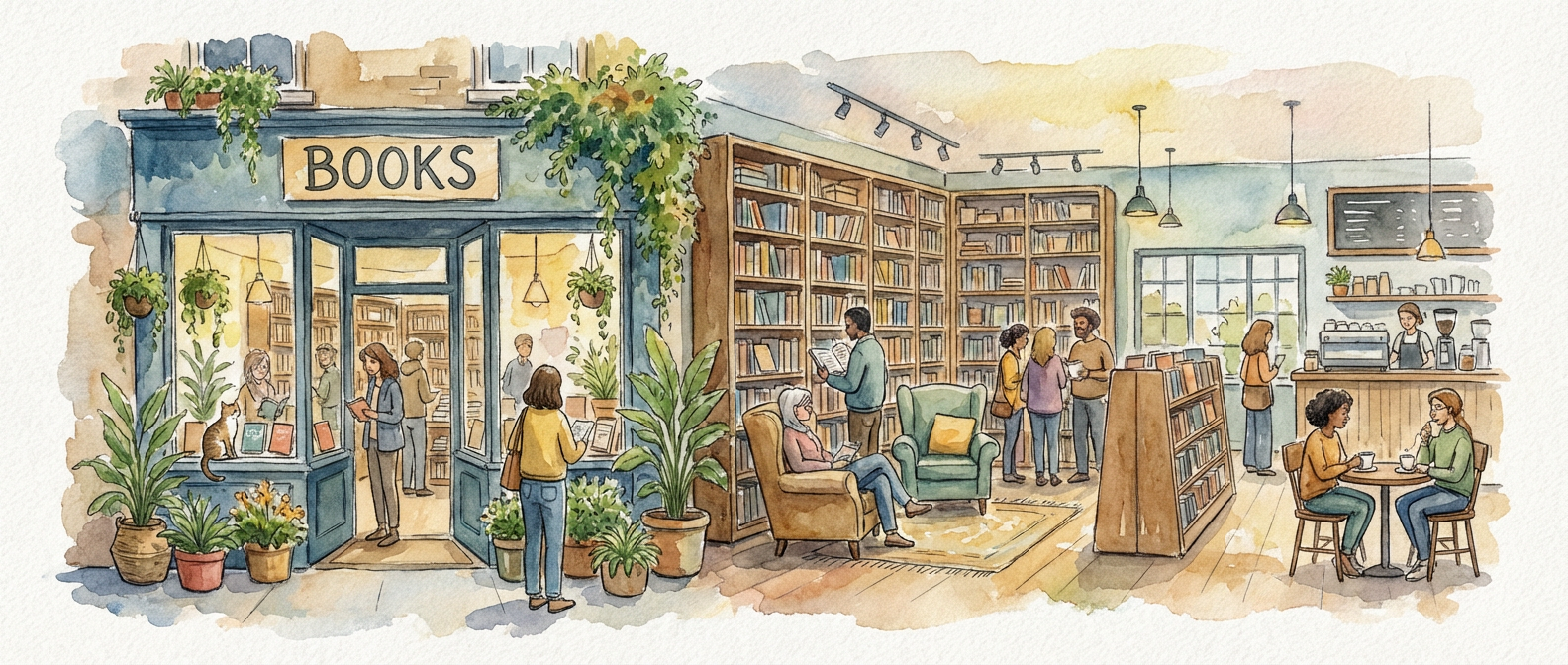
Walk into any thriving indie bookstore today and you’ll see the same formula. It’s not really about books anymore, though books are obviously central. It’s about being the third place your neighborhood didn’t know it needed. Coffee bar, event space, community bulletin board, art gallery, wine shop, gift boutique. All wrapped around a carefully curated book selection that reflects the owner’s actual taste, not some corporate algorithm.
The stores that made it through are genuinely different animals than what came before. Take Greenlight Bookstore in Brooklyn. They survived by becoming a neighborhood institution first and a bookstore second. School fundraisers, political organizing meetings, first date location, weekend hangout spot. They sell books, but they’re really selling belonging.
The economics work now in ways they didn’t fifteen years ago. Higher margins on events, merchandise, and food offset the lower margins on books. Customers pay more, but they get more. A $30 hardcover feels reasonable when it comes with a glass of wine, a conversation with the author, and a sense of being part of something.
The ABA now counts over 3,000 member stores. Still below the peak, but growing steadily. More importantly, the new stores opening aren’t desperate Hail Marys. They’re confident businesses with clear value propositions and sustainable models.
What Comes Next
The indie bookstore comeback is real, but it’s also fragile. Rising rents in gentrifying neighborhoods threaten even successful stores. The next economic downturn could easily reverse the gains. And the stores that are thriving now might struggle to maintain their edge as the novelty wears off.
But I’m betting on the bookstores that figured out how to be essential to their communities. The ones that became gathering places, not just retail spaces. The ones where the staff knows your name and your reading preferences. Where local authors come to test new material and neighbors argue about city council elections.
The bookstore of 2024 isn’t trying to be Amazon’s physical cousin. It’s trying to be the living room of its neighborhood. And honestly? That’s a much more interesting business to be in.
What’s your local bookstore doing that keeps you coming back? I’m always hunting for the next evolution in indie bookstore culture, so hit me up if you’ve spotted something worth talking about.
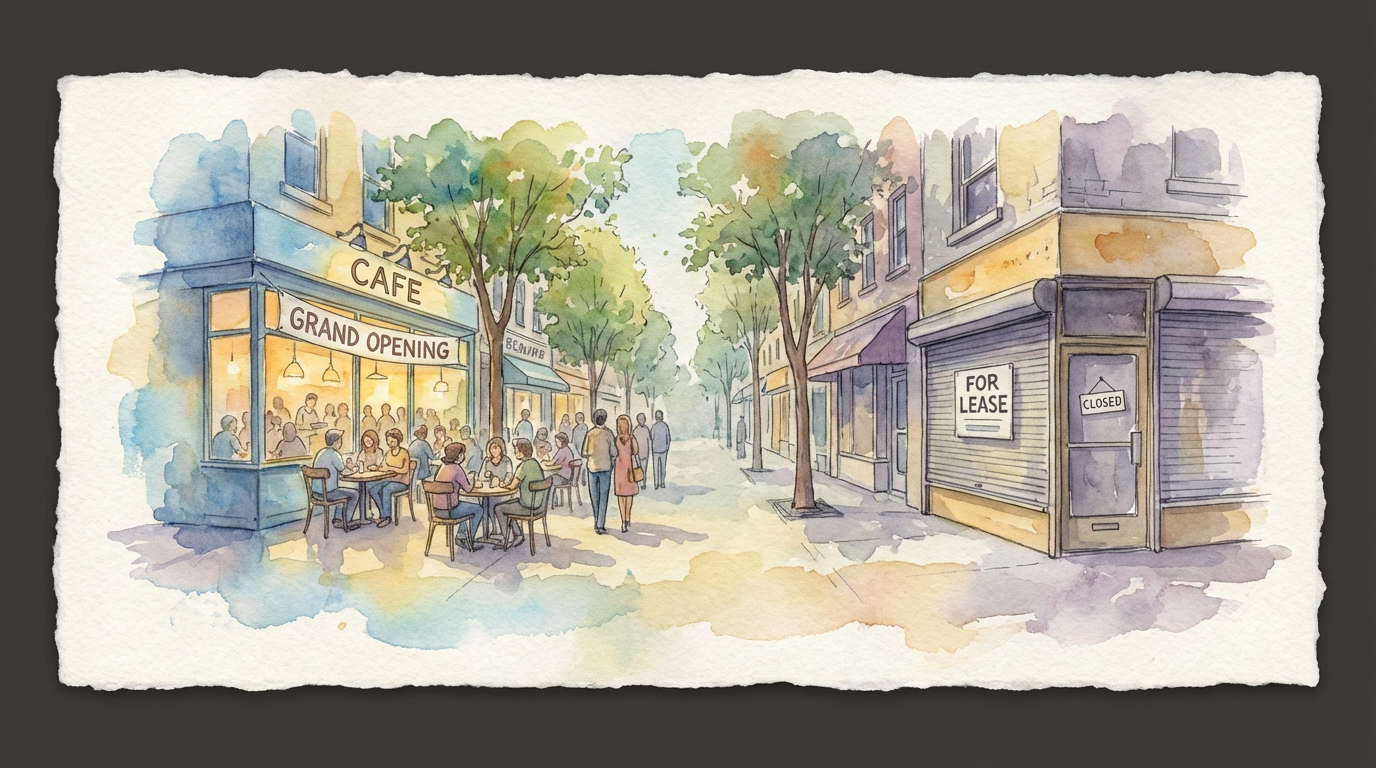
The Block That Became a Mirror: How Restaurant Turnover Tells Our Neighborhood’s Story
The Corner Where Dreams Go to Die (Or Get Reborn)
You know that corner spot on Elmwood where three restaurants have opened and closed in two years? Yeah, that one. The place that was briefly a Peruvian-Korean fusion joint, then a farm-to-table breakfast spot, then a cocktail bar that never quite figured out its vibe. I’ve been watching that space like it’s a soap opera, and honestly, it’s become this weird barometer for what’s happening to our whole neighborhood.
The latest casualty was Marigold, the breakfast place that made these incredible cardamom pancakes but somehow never had more than four tables occupied at once. Sarah, the owner, told me last week she’s moving back to Portland. “I thought I understood this neighborhood,” she said, boxing up the last of her mismatched vintage plates. “But I was cooking for the neighborhood I wanted, not the one that actually lives here.”
That hit different. Because aren’t we all kind of doing that? Projecting our vision of what this place should be instead of seeing what it actually is?
The Survivors Know Something We Don’t
Walk two blocks down and you’ll find Rosa’s Tamales, which has been slinging the same six varieties from the same corner cart for twelve years. Rosa doesn’t have Instagram. She doesn’t do small plates or craft cocktails. She just shows up at 7 AM with perfectly steamed masa and a line of construction workers who’ve been coming since her first week.
Then there’s Nakamura, the sushi spot that looks like it hasn’t been updated since 1987, because it hasn’t. Ken behind the counter still remembers your usual, still hand-writes every order on the same carbon paper tickets. The fish is pristine, the rice is perfect, and somehow they’re busier now than they were five years ago. While everyone else pivoted and adapted and optimized, they just kept being exactly what they always were.
These places survive because they solved a real problem for real people, not because they nailed their brand aesthetic. They’re not performing neighborhood authenticity. They just are the neighborhood.
The New Wave Isn’t What You Think
But here’s the plot twist: the most successful new openings aren’t trying to be the next big thing. They’re filling gaps that longtime residents actually have. Like Comfort Station, which opened last month in the old hardware store space. It’s basically a cafeteria-style joint run by three women who moved here from New Orleans. No reservations, no small plates, just really good red beans and rice for eight bucks.
The line stretches down the block every lunch hour because they figured out something simple: people who work in this neighborhood need affordable lunch that doesn’t taste like cardboard. Revolutionary stuff, I know.
Same with Midnight Oil, the 24-hour diner that took over the failed cocktail bar space. The owners looked around and realized we had plenty of places to get a fifteen-dollar cocktail, but nowhere to get decent eggs at 2 AM. Now it’s packed with night shift workers, insomniacs, and anyone who needs coffee that doesn’t cost more than a tank of gas.
The Economics of Dreaming
The thing is, restaurant failure isn’t really about the food. It’s about rent, and timing, and reading the room correctly. That gorgeous cocktail bar that lasted six months? They were paying $8,000 a month for a space that needed $15,000 in monthly sales just to break even. Their drinks were incredible, but they needed to sell a lot of incredible drinks to a neighborhood where most people think twelve dollars for a cocktail is insane.
Meanwhile, Rosa’s cart costs her maybe $200 a month in permits and supplies. She owns her equipment outright. Her overhead is basically nothing, which means she can sell a perfect tamale for three dollars and still make a living. It’s not romantic, but it’s sustainable in a way that most restaurant dreams just aren’t.
I’m not saying ambition is bad. I’m saying that understanding your context isn’t just smart business, it’s respectful to the people who live here. When you open a restaurant that only works if the neighborhood completely changes around it, you’re basically betting against your own customers.
What the Empty Storefronts Tell Us
Every closed restaurant is a story about who thought they belonged here and how that played out. The Ethiopian place that couldn’t survive COVID restrictions. The wine bar that never figured out how to appeal to anyone except other wine bar owners. The pizza joint that was actually pretty good but opened right when three other pizza places opened within four blocks.
But they’re also stories about rising rents and impossible margins and the weird pressure to be everything to everyone while social media watches. The owners pour their savings and their dreams into these spaces, and when it doesn’t work, they don’t just lose money. They lose their vision of themselves, their place in the community they wanted to serve.
The empty storefronts aren’t just economic failures. They’re reminders that community isn’t something you can manufacture or optimize. It either happens or it doesn’t, and you can’t force it by having the right lighting and the perfect playlist.
What’s your corner like? Are you seeing the same patterns where you live? I’m curious about which places survive in your neighborhood and what they know that the failed experiments missed. Because every neighborhood is different, but I suspect the lessons are pretty universal.


The Last Light at Murphy’s Tavern
The Quiet Death of a Corner Institution
Murphy’s Tavern closed last Tuesday. No fanfare, no farewell party, just a handwritten sign taped to the window that read “Thanks for 47 years.” By Thursday, the neon shamrock was gone. By Saturday, someone had already scraped off the painted address numbers.
I found out the way you find out about most neighborhood deaths these days, walking past and noticing something was wrong. The daily rhythm got disrupted. No regulars smoking outside at 2 PM. No sound of the Cubs game drifting onto Ashland Avenue. Just the hollow echo of change that hits you before your brain catches up.
Forty-seven years. That’s longer than most marriages, longer than most careers, longer than the lifespan of entire cultural movements. Murphy’s outlasted three economic crashes, two pandemics, and the gentrification wave that claimed O’Malley’s down the street in 2019. But it couldn’t outlast the rent increase that arrived with last month’s lease renewal.
What Dies When a Neighborhood Bar Dies
The bartender’s name was Diane. She knew your drink by your third visit and your problems by your tenth. She kept photos behind the register, customers’ weddings, babies, graduations, an analog social media wall that stretched back decades. Those photos are probably in a cardboard box now, or worse, in a dumpster.
Murphy’s was never Instagram pretty. The floors were sticky, the jukebox played half the songs too quiet and half too loud, and the bathroom door handle had been broken since the Clinton administration. But it was the kind of place where the city electrician grabbed lunch next to the local playwright, where the woman from the dry cleaner played trivia with kids from the art school.
These accidental encounters, the urban anthropologist Jane Jacobs called them “weak ties,” are what make neighborhoods actual communities instead of just collections of addresses. Murphy’s created hundreds of these small connections every week. That infrastructure doesn’t relocate when the lease runs out. It just disappears.
The Mathematics of Cultural Loss
Here’s what the numbers look like: Murphy’s had 12 regular trivia teams, employed four people full-time, and was the unofficial headquarters for the local softball league. The Wednesday open mic launched at least six musicians who now play venues across the city. The back room held AA meetings every Tuesday and Thursday for 15 years.
The building owner plans to convert the space into luxury condos. Two-bedroom units starting at $3,200. The math is simple and brutal: one tavern becomes four apartments, four families move in, but the neighborhood loses its living room.
This isn’t about nostalgia or resistance to change. Cities evolve. People move. Businesses close. But when cultural gathering spaces disappear faster than they’re replaced, something essential breaks down. The community infrastructure, the places where strangers become neighbors and neighbors become friends, gets paved over by profit margins.
Reading the Signs
Murphy’s death wasn’t sudden. The signs were there for months if you knew how to read them. The beer selection slowly shrinking. The trivia night prizes getting smaller. The way Diane started asking longtime customers how they were doing with a different kind of attention, like she was trying to memorize their faces.
The ghost signs are appearing already. The faded outline where the tavern sign hung. The worn patch of sidewalk where regulars stood to smoke. The slightly different color of brick where the awning used to attach. These physical traces will fade too, but they’re readable now for anyone who pays attention to the city’s handwriting.
Walk through any changing neighborhood and you’ll find these archaeological layers. The outline of old signage bleeding through fresh paint. Anchor bolts in the sidewalk where newspaper boxes used to stand. The emotional geography of a place lives in these details, the small evidence of what used to matter here.
What Grows in Empty Lots
The mourning period for neighborhood institutions is brief. Murphy’s has been closed for eight days and people are already forgetting the exact layout of the bar, the color of the walls, the way the afternoon light hit the front windows. Memory fades faster than you’d expect.
But something interesting happens in the spaces left behind. The trivia teams are talking about finding a new home. The musicians from the open mic are planning their own monthly series. The softball league is looking at the park district building. Community has a way of finding itself, even when its old container disappears.
The question isn’t whether the neighborhood will survive losing Murphy’s. It will. The question is what kind of place it becomes in the absence of spaces like this. More efficient, probably. More profitable, definitely. But will it still be the kind of place where the city electrician and the local playwright end up at the same table, solving the world’s problems over cheap beer and expensive conversation?
If you knew Murphy’s, share a story. If you didn’t, pay attention to the corner bars and coffee shops and community centers that are still hanging on in your neighborhood. These places matter more than we realize until they’re gone. And once they’re gone, they’re gone for good.
The Connectors: Three Community Organizers Reshaping Neighborhoods One Conversation at a Time
Maya Chen: Building Bridges Through Breakfasts
Maya Chen starts her Tuesday mornings at 5:30 AM, not because she’s a masochist, but because the Sunrise Community Kitchen doesn’t set itself up. By 7 AM, she’s got coffee brewing in industrial-sized urns and volunteers arranging donated pastries from three local bakeries. What started as a monthly neighborhood breakfast in Riverside Park has become the kind of gathering that city planners study and other organizers try to replicate.
Chen didn’t set out to become a community organizer. She was working tech support at a startup downtown when the pandemic hit and her building’s management company started threatening evictions. “I just started knocking on doors,” she tells me, stirring oat milk into her cortado at Grind Coffee. “Turns out half my neighbors were dealing with the same stuff, but we’d never talked before.” That door-knocking campaign saved seventeen families from displacement and taught Chen something important about neighborhood organizing: people want to connect, they just need a reason.
The breakfast gatherings evolved naturally. First it was tenants meeting in Chen’s apartment, then spilling into the courtyard, then moving to the park when the weather got nice. Now the monthly Sunrise feeds 200+ people and has spawned everything from a tool library to a community childcare collective. Chen’s genius isn’t in grand gestures but in creating spaces where connections happen organically. She knows that real change comes from relationships, not rallies.
What makes Chen’s approach work is her attention to the details that make people feel seen. She remembers that Mrs. Rodriguez prefers her coffee black, that the Johnsons’ kid is allergic to gluten, that David from 4B is looking for work in carpentry. These aren’t just pleasantries, they’re the foundation of community organizing that actually lasts. When the next crisis hits, people show up because they know Chen shows up for them.
James Okello: The Art of Political Translation
James Okello speaks three languages fluently: English, Swahili, and City Council. The third might be the most important for his work organizing East Portland’s immigrant communities around housing and transportation issues. Okello came to Portland fifteen years ago as a refugee from Kenya and spent his first decade learning how American civic engagement actually works, not the textbook version, but the real mechanics of who has power and how decisions get made.
“People think organizing is about protests and petitions,” Okello says, sitting in his cluttered office above Nyama Mama restaurant on Division. “But mostly it’s translation work. Taking what city planners say and explaining what it means for families who might lose their housing. Taking what families need and putting it in language that bureaucrats understand.” His walls are covered with transit maps, zoning documents, and photos from community meetings that look more like family gatherings than political events.
Okello’s breakthrough came during the 2019 fight over the Orange Line extension. City transportation planners held their required community input sessions, but they scheduled them during work hours and provided interpretation only in Spanish. Okello organized parallel meetings in community centers and religious spaces, with interpretation in Somali, Arabic, and Vietnamese. The input from those grassroots sessions fundamentally changed the project’s scope, adding pedestrian infrastructure and affordable housing components that the original plan ignored.
The secret to Okello’s effectiveness is that he never operates alone. He’s built a network of community liaisons who understand both their neighbors’ needs and the systems they’re trying to navigate. When someone in the Somali community needs help understanding a property tax notice, they call Amina, who connects them with Okello. When Vietnamese families are worried about gentrification, they talk to Duc, who brings their concerns to the monthly organizers’ meeting. It’s political organizing as extended family network.
Rosa Martinez: Mutual Aid as Resistance
Rosa Martinez runs the city’s most efficient food distribution network out of a converted garage behind her house in Barrio Logan. Every Saturday, volunteers sort through donations from grocery stores, restaurants, and community gardens, packaging them into bags that feed 150+ families. But calling it a food bank misses the point entirely. Martinez has built something closer to a neighborhood ecosystem, a web of relationships that redistributes resources and builds collective power.
Martinez learned organizing from her grandmother, who ran informal mutual aid networks in rural Oaxaca. “Mija,” she told me her abuela used to say, “the government’s job is to make you think you’re alone. Our job is to prove them wrong.” That philosophy shapes everything Martinez does, from the way she structures volunteer shifts to the financial literacy workshops she runs in the garage on Thursday nights. The food distribution is just the entry point. The real work is building connections that outlast any single crisis.
The numbers tell part of the story: since 2020, Martinez’s network has distributed over 50,000 pounds of food and helped 200+ families navigate pandemic relief programs. But the deeper impact shows up in smaller ways. Neighbors sharing babysitting duties so single parents can work. High school students tutoring elementary kids after school. Families pooling resources to buy a house collectively when individual homeownership becomes impossible. Martinez didn’t plan these developments, she created conditions where they could emerge naturally.
What sets Martinez apart is her understanding that mutual aid isn’t charity, it’s organizing. Every food pickup is a chance to talk about tenant rights. Every volunteer shift includes conversations about immigration policy or healthcare access. When families build relationships through sharing resources, they also build the trust necessary for political action. Martinez knows that people fight harder for communities they’ve helped create than for abstract principles they’ve been told to care about.
The Infrastructure of Care
Chen, Okello, and Martinez work in different neighborhoods and focus on different issues, but they share a common understanding: real social change happens through relationships, not rhetoric. They’re building what adrienne maree brown calls “emergent strategy”, organizing that grows from community needs rather than imposed from outside agendas. Their meetings happen in kitchens and community centers, not conference rooms. Their victories look like neighbors knowing each other’s names, not just policy wins.
What makes their work sustainable is that they’ve figured out how to make organizing feel good. Chen’s breakfast gatherings are genuinely fun. Okello’s planning meetings include childcare and end with shared meals. Martinez’s distribution events feel like block parties. They understand that people need reasons to stay involved beyond righteous anger. They need joy, connection, and the satisfaction of meaningful work done alongside people they trust.
These organizers represent a shift in how community building happens in American cities. They’re less interested in scaling up than in going deeper. Less focused on media attention than on neighbor relationships. They’re proving that the most effective political organizing often looks like good hospitality, and that revolution might start with remembering each other’s names.
Know an organizer whose work deserves more attention? I’m always looking for stories about people building community in unexpected ways. Drop me a line with their details. The best organizing often happens quietly, and these stories deserve to be shared.