The Block That Became a Mirror: How Restaurant Turnover Tells Our Neighborhood’s Story
The Corner Where Dreams Go to Die (Or Get Reborn)
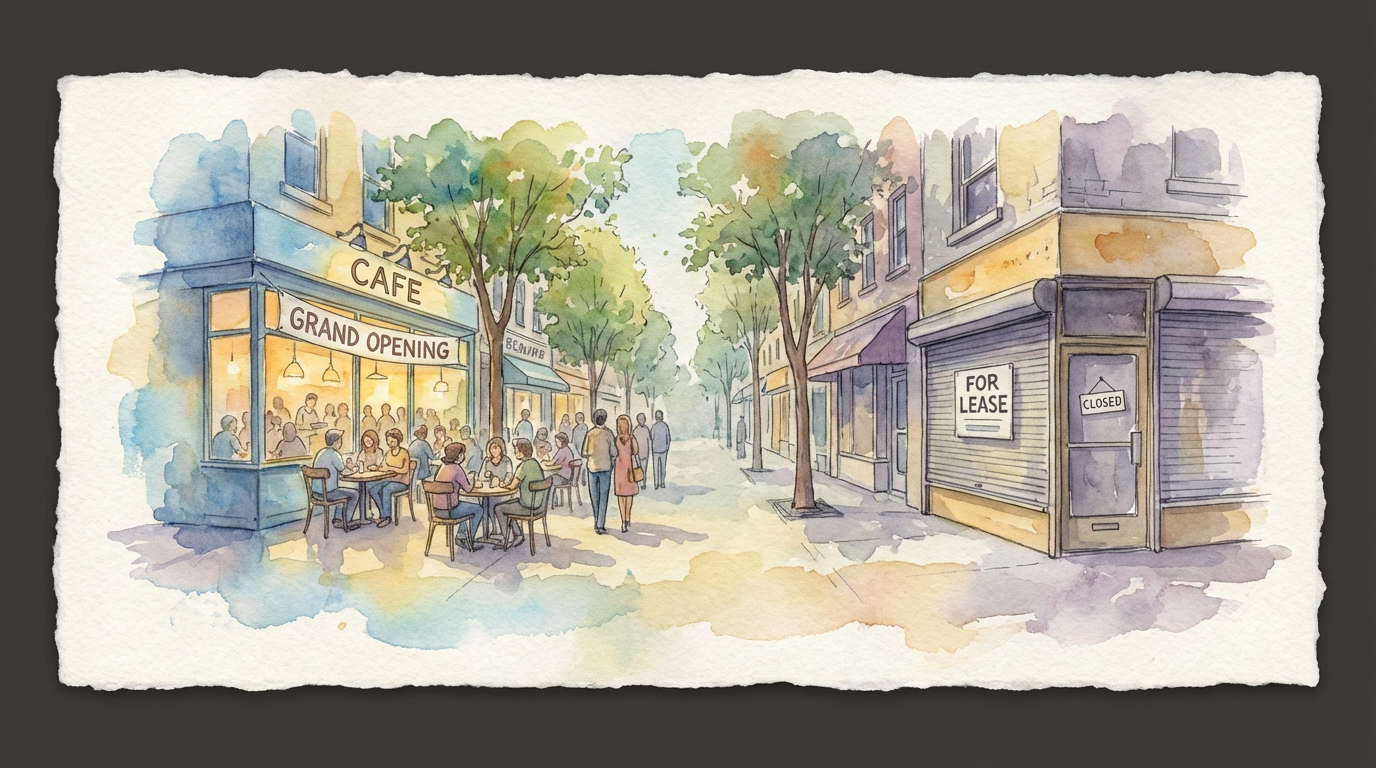
You know that corner spot on Elmwood where three restaurants have opened and closed in two years? Yeah, that one. The place that was briefly a Peruvian-Korean fusion joint, then a farm-to-table breakfast spot, then a cocktail bar that never quite figured out its vibe. I’ve been watching that space like it’s a soap opera, and honestly, it’s become this weird barometer for what’s happening to our whole neighborhood.
The latest casualty was Marigold, the breakfast place that made these incredible cardamom pancakes but somehow never had more than four tables occupied at once. Sarah, the owner, told me last week she’s moving back to Portland. “I thought I understood this neighborhood,” she said, boxing up the last of her mismatched vintage plates. “But I was cooking for the neighborhood I wanted, not the one that actually lives here.”
That hit different. Because aren’t we all kind of doing that? Projecting our vision of what this place should be instead of seeing what it actually is?
The Survivors Know Something We Don’t
Walk two blocks down and you’ll find Rosa’s Tamales, which has been slinging the same six varieties from the same corner cart for twelve years. Rosa doesn’t have Instagram. She doesn’t do small plates or craft cocktails. She just shows up at 7 AM with perfectly steamed masa and a line of construction workers who’ve been coming since her first week.
Then there’s Nakamura, the sushi spot that looks like it hasn’t been updated since 1987, because it hasn’t. Ken behind the counter still remembers your usual, still hand-writes every order on the same carbon paper tickets. The fish is pristine, the rice is perfect, and somehow they’re busier now than they were five years ago. While everyone else pivoted and adapted and optimized, they just kept being exactly what they always were.
These places survive because they solved a real problem for real people, not because they nailed their brand aesthetic. They’re not performing neighborhood authenticity. They just are the neighborhood.
The New Wave Isn’t What You Think
But here’s the plot twist: the most successful new openings aren’t trying to be the next big thing. They’re filling gaps that longtime residents actually have. Like Comfort Station, which opened last month in the old hardware store space. It’s basically a cafeteria-style joint run by three women who moved here from New Orleans. No reservations, no small plates, just really good red beans and rice for eight bucks.
The line stretches down the block every lunch hour because they figured out something simple: people who work in this neighborhood need affordable lunch that doesn’t taste like cardboard. Revolutionary stuff, I know.
Same with Midnight Oil, the 24-hour diner that took over the failed cocktail bar space. The owners looked around and realized we had plenty of places to get a fifteen-dollar cocktail, but nowhere to get decent eggs at 2 AM. Now it’s packed with night shift workers, insomniacs, and anyone who needs coffee that doesn’t cost more than a tank of gas.
The Economics of Dreaming
The thing is, restaurant failure isn’t really about the food. It’s about rent, and timing, and reading the room correctly. That gorgeous cocktail bar that lasted six months? They were paying $8,000 a month for a space that needed $15,000 in monthly sales just to break even. Their drinks were incredible, but they needed to sell a lot of incredible drinks to a neighborhood where most people think twelve dollars for a cocktail is insane.
Meanwhile, Rosa’s cart costs her maybe $200 a month in permits and supplies. She owns her equipment outright. Her overhead is basically nothing, which means she can sell a perfect tamale for three dollars and still make a living. It’s not romantic, but it’s sustainable in a way that most restaurant dreams just aren’t.
I’m not saying ambition is bad. I’m saying that understanding your context isn’t just smart business, it’s respectful to the people who live here. When you open a restaurant that only works if the neighborhood completely changes around it, you’re basically betting against your own customers.
What the Empty Storefronts Tell Us
Every closed restaurant is a story about who thought they belonged here and how that played out. The Ethiopian place that couldn’t survive COVID restrictions. The wine bar that never figured out how to appeal to anyone except other wine bar owners. The pizza joint that was actually pretty good but opened right when three other pizza places opened within four blocks.
But they’re also stories about rising rents and impossible margins and the weird pressure to be everything to everyone while social media watches. The owners pour their savings and their dreams into these spaces, and when it doesn’t work, they don’t just lose money. They lose their vision of themselves, their place in the community they wanted to serve.
The empty storefronts aren’t just economic failures. They’re reminders that community isn’t something you can manufacture or optimize. It either happens or it doesn’t, and you can’t force it by having the right lighting and the perfect playlist.
What’s your corner like? Are you seeing the same patterns where you live? I’m curious about which places survive in your neighborhood and what they know that the failed experiments missed. Because every neighborhood is different, but I suspect the lessons are pretty universal.
Comments are Disabled