Posts in Category: Uncategorized
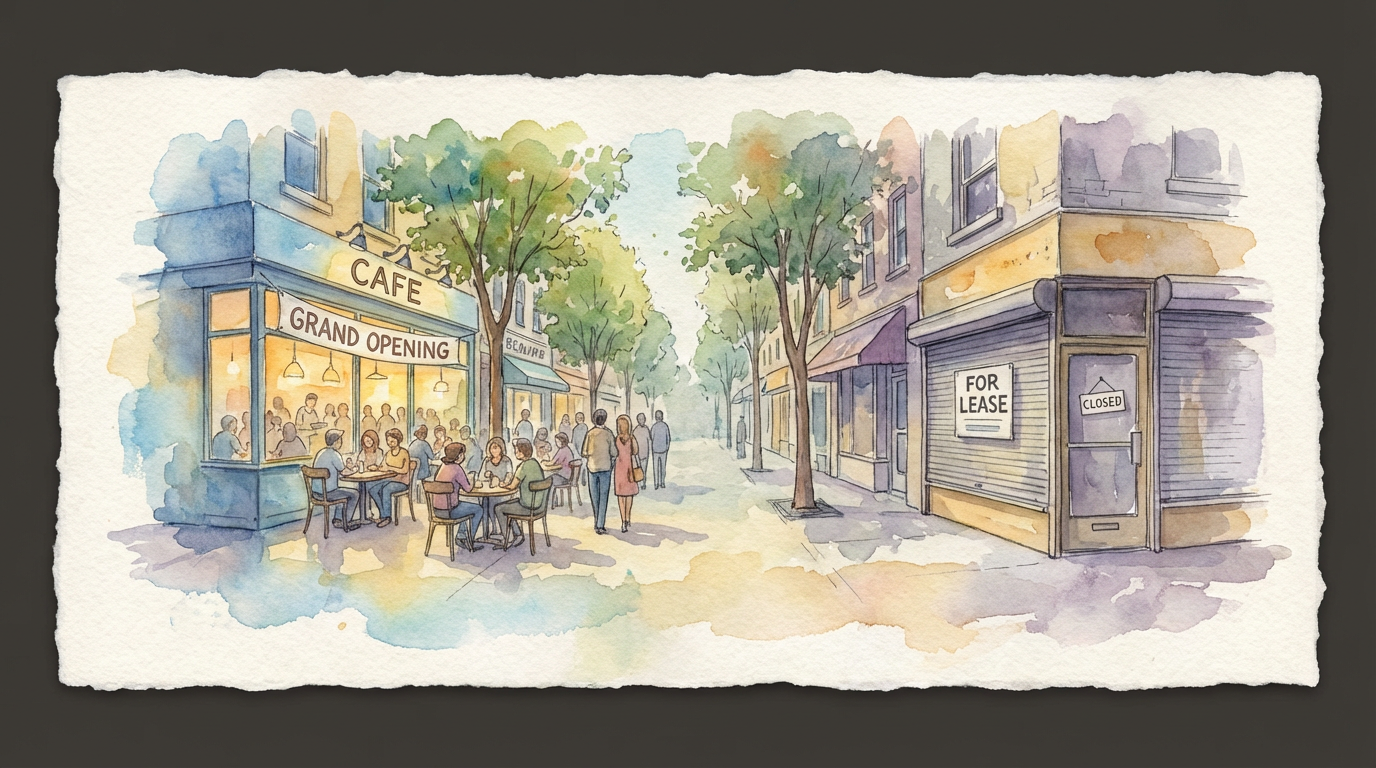
The Block That Became a Mirror: How Restaurant Turnover Tells Our Neighborhood’s Story
The Corner Where Dreams Go to Die (Or Get Reborn)
You know that corner spot on Elmwood where three restaurants have opened and closed in two years? Yeah, that one. The place that was briefly a Peruvian-Korean fusion joint, then a farm-to-table breakfast spot, then a cocktail bar that never quite figured out its vibe. I’ve been watching that space like it’s a soap opera, and honestly, it’s become this weird barometer for what’s happening to our whole neighborhood.
The latest casualty was Marigold, the breakfast place that made these incredible cardamom pancakes but somehow never had more than four tables occupied at once. Sarah, the owner, told me last week she’s moving back to Portland. “I thought I understood this neighborhood,” she said, boxing up the last of her mismatched vintage plates. “But I was cooking for the neighborhood I wanted, not the one that actually lives here.”
That hit different. Because aren’t we all kind of doing that? Projecting our vision of what this place should be instead of seeing what it actually is?
The Survivors Know Something We Don’t
Walk two blocks down and you’ll find Rosa’s Tamales, which has been slinging the same six varieties from the same corner cart for twelve years. Rosa doesn’t have Instagram. She doesn’t do small plates or craft cocktails. She just shows up at 7 AM with perfectly steamed masa and a line of construction workers who’ve been coming since her first week.
Then there’s Nakamura, the sushi spot that looks like it hasn’t been updated since 1987, because it hasn’t. Ken behind the counter still remembers your usual, still hand-writes every order on the same carbon paper tickets. The fish is pristine, the rice is perfect, and somehow they’re busier now than they were five years ago. While everyone else pivoted and adapted and optimized, they just kept being exactly what they always were.
These places survive because they solved a real problem for real people, not because they nailed their brand aesthetic. They’re not performing neighborhood authenticity. They just are the neighborhood.
The New Wave Isn’t What You Think
But here’s the plot twist: the most successful new openings aren’t trying to be the next big thing. They’re filling gaps that longtime residents actually have. Like Comfort Station, which opened last month in the old hardware store space. It’s basically a cafeteria-style joint run by three women who moved here from New Orleans. No reservations, no small plates, just really good red beans and rice for eight bucks.
The line stretches down the block every lunch hour because they figured out something simple: people who work in this neighborhood need affordable lunch that doesn’t taste like cardboard. Revolutionary stuff, I know.
Same with Midnight Oil, the 24-hour diner that took over the failed cocktail bar space. The owners looked around and realized we had plenty of places to get a fifteen-dollar cocktail, but nowhere to get decent eggs at 2 AM. Now it’s packed with night shift workers, insomniacs, and anyone who needs coffee that doesn’t cost more than a tank of gas.
The Economics of Dreaming
The thing is, restaurant failure isn’t really about the food. It’s about rent, and timing, and reading the room correctly. That gorgeous cocktail bar that lasted six months? They were paying $8,000 a month for a space that needed $15,000 in monthly sales just to break even. Their drinks were incredible, but they needed to sell a lot of incredible drinks to a neighborhood where most people think twelve dollars for a cocktail is insane.
Meanwhile, Rosa’s cart costs her maybe $200 a month in permits and supplies. She owns her equipment outright. Her overhead is basically nothing, which means she can sell a perfect tamale for three dollars and still make a living. It’s not romantic, but it’s sustainable in a way that most restaurant dreams just aren’t.
I’m not saying ambition is bad. I’m saying that understanding your context isn’t just smart business, it’s respectful to the people who live here. When you open a restaurant that only works if the neighborhood completely changes around it, you’re basically betting against your own customers.
What the Empty Storefronts Tell Us
Every closed restaurant is a story about who thought they belonged here and how that played out. The Ethiopian place that couldn’t survive COVID restrictions. The wine bar that never figured out how to appeal to anyone except other wine bar owners. The pizza joint that was actually pretty good but opened right when three other pizza places opened within four blocks.
But they’re also stories about rising rents and impossible margins and the weird pressure to be everything to everyone while social media watches. The owners pour their savings and their dreams into these spaces, and when it doesn’t work, they don’t just lose money. They lose their vision of themselves, their place in the community they wanted to serve.
The empty storefronts aren’t just economic failures. They’re reminders that community isn’t something you can manufacture or optimize. It either happens or it doesn’t, and you can’t force it by having the right lighting and the perfect playlist.
What’s your corner like? Are you seeing the same patterns where you live? I’m curious about which places survive in your neighborhood and what they know that the failed experiments missed. Because every neighborhood is different, but I suspect the lessons are pretty universal.


The Last Light at Murphy’s Tavern
The Quiet Death of a Corner Institution
Murphy’s Tavern closed last Tuesday. No fanfare, no farewell party, just a handwritten sign taped to the window that read “Thanks for 47 years.” By Thursday, the neon shamrock was gone. By Saturday, someone had already scraped off the painted address numbers.
I found out the way you find out about most neighborhood deaths these days, walking past and noticing something was wrong. The daily rhythm got disrupted. No regulars smoking outside at 2 PM. No sound of the Cubs game drifting onto Ashland Avenue. Just the hollow echo of change that hits you before your brain catches up.
Forty-seven years. That’s longer than most marriages, longer than most careers, longer than the lifespan of entire cultural movements. Murphy’s outlasted three economic crashes, two pandemics, and the gentrification wave that claimed O’Malley’s down the street in 2019. But it couldn’t outlast the rent increase that arrived with last month’s lease renewal.
What Dies When a Neighborhood Bar Dies
The bartender’s name was Diane. She knew your drink by your third visit and your problems by your tenth. She kept photos behind the register, customers’ weddings, babies, graduations, an analog social media wall that stretched back decades. Those photos are probably in a cardboard box now, or worse, in a dumpster.
Murphy’s was never Instagram pretty. The floors were sticky, the jukebox played half the songs too quiet and half too loud, and the bathroom door handle had been broken since the Clinton administration. But it was the kind of place where the city electrician grabbed lunch next to the local playwright, where the woman from the dry cleaner played trivia with kids from the art school.
These accidental encounters, the urban anthropologist Jane Jacobs called them “weak ties,” are what make neighborhoods actual communities instead of just collections of addresses. Murphy’s created hundreds of these small connections every week. That infrastructure doesn’t relocate when the lease runs out. It just disappears.
The Mathematics of Cultural Loss
Here’s what the numbers look like: Murphy’s had 12 regular trivia teams, employed four people full-time, and was the unofficial headquarters for the local softball league. The Wednesday open mic launched at least six musicians who now play venues across the city. The back room held AA meetings every Tuesday and Thursday for 15 years.
The building owner plans to convert the space into luxury condos. Two-bedroom units starting at $3,200. The math is simple and brutal: one tavern becomes four apartments, four families move in, but the neighborhood loses its living room.
This isn’t about nostalgia or resistance to change. Cities evolve. People move. Businesses close. But when cultural gathering spaces disappear faster than they’re replaced, something essential breaks down. The community infrastructure, the places where strangers become neighbors and neighbors become friends, gets paved over by profit margins.
Reading the Signs
Murphy’s death wasn’t sudden. The signs were there for months if you knew how to read them. The beer selection slowly shrinking. The trivia night prizes getting smaller. The way Diane started asking longtime customers how they were doing with a different kind of attention, like she was trying to memorize their faces.
The ghost signs are appearing already. The faded outline where the tavern sign hung. The worn patch of sidewalk where regulars stood to smoke. The slightly different color of brick where the awning used to attach. These physical traces will fade too, but they’re readable now for anyone who pays attention to the city’s handwriting.
Walk through any changing neighborhood and you’ll find these archaeological layers. The outline of old signage bleeding through fresh paint. Anchor bolts in the sidewalk where newspaper boxes used to stand. The emotional geography of a place lives in these details, the small evidence of what used to matter here.
What Grows in Empty Lots
The mourning period for neighborhood institutions is brief. Murphy’s has been closed for eight days and people are already forgetting the exact layout of the bar, the color of the walls, the way the afternoon light hit the front windows. Memory fades faster than you’d expect.
But something interesting happens in the spaces left behind. The trivia teams are talking about finding a new home. The musicians from the open mic are planning their own monthly series. The softball league is looking at the park district building. Community has a way of finding itself, even when its old container disappears.
The question isn’t whether the neighborhood will survive losing Murphy’s. It will. The question is what kind of place it becomes in the absence of spaces like this. More efficient, probably. More profitable, definitely. But will it still be the kind of place where the city electrician and the local playwright end up at the same table, solving the world’s problems over cheap beer and expensive conversation?
If you knew Murphy’s, share a story. If you didn’t, pay attention to the corner bars and coffee shops and community centers that are still hanging on in your neighborhood. These places matter more than we realize until they’re gone. And once they’re gone, they’re gone for good.
The Connectors: Three Community Organizers Reshaping Neighborhoods One Conversation at a Time
Maya Chen: Building Bridges Through Breakfasts
Maya Chen starts her Tuesday mornings at 5:30 AM, not because she’s a masochist, but because the Sunrise Community Kitchen doesn’t set itself up. By 7 AM, she’s got coffee brewing in industrial-sized urns and volunteers arranging donated pastries from three local bakeries. What started as a monthly neighborhood breakfast in Riverside Park has become the kind of gathering that city planners study and other organizers try to replicate.
Chen didn’t set out to become a community organizer. She was working tech support at a startup downtown when the pandemic hit and her building’s management company started threatening evictions. “I just started knocking on doors,” she tells me, stirring oat milk into her cortado at Grind Coffee. “Turns out half my neighbors were dealing with the same stuff, but we’d never talked before.” That door-knocking campaign saved seventeen families from displacement and taught Chen something important about neighborhood organizing: people want to connect, they just need a reason.
The breakfast gatherings evolved naturally. First it was tenants meeting in Chen’s apartment, then spilling into the courtyard, then moving to the park when the weather got nice. Now the monthly Sunrise feeds 200+ people and has spawned everything from a tool library to a community childcare collective. Chen’s genius isn’t in grand gestures but in creating spaces where connections happen organically. She knows that real change comes from relationships, not rallies.
What makes Chen’s approach work is her attention to the details that make people feel seen. She remembers that Mrs. Rodriguez prefers her coffee black, that the Johnsons’ kid is allergic to gluten, that David from 4B is looking for work in carpentry. These aren’t just pleasantries, they’re the foundation of community organizing that actually lasts. When the next crisis hits, people show up because they know Chen shows up for them.
James Okello: The Art of Political Translation
James Okello speaks three languages fluently: English, Swahili, and City Council. The third might be the most important for his work organizing East Portland’s immigrant communities around housing and transportation issues. Okello came to Portland fifteen years ago as a refugee from Kenya and spent his first decade learning how American civic engagement actually works, not the textbook version, but the real mechanics of who has power and how decisions get made.
“People think organizing is about protests and petitions,” Okello says, sitting in his cluttered office above Nyama Mama restaurant on Division. “But mostly it’s translation work. Taking what city planners say and explaining what it means for families who might lose their housing. Taking what families need and putting it in language that bureaucrats understand.” His walls are covered with transit maps, zoning documents, and photos from community meetings that look more like family gatherings than political events.
Okello’s breakthrough came during the 2019 fight over the Orange Line extension. City transportation planners held their required community input sessions, but they scheduled them during work hours and provided interpretation only in Spanish. Okello organized parallel meetings in community centers and religious spaces, with interpretation in Somali, Arabic, and Vietnamese. The input from those grassroots sessions fundamentally changed the project’s scope, adding pedestrian infrastructure and affordable housing components that the original plan ignored.
The secret to Okello’s effectiveness is that he never operates alone. He’s built a network of community liaisons who understand both their neighbors’ needs and the systems they’re trying to navigate. When someone in the Somali community needs help understanding a property tax notice, they call Amina, who connects them with Okello. When Vietnamese families are worried about gentrification, they talk to Duc, who brings their concerns to the monthly organizers’ meeting. It’s political organizing as extended family network.
Rosa Martinez: Mutual Aid as Resistance
Rosa Martinez runs the city’s most efficient food distribution network out of a converted garage behind her house in Barrio Logan. Every Saturday, volunteers sort through donations from grocery stores, restaurants, and community gardens, packaging them into bags that feed 150+ families. But calling it a food bank misses the point entirely. Martinez has built something closer to a neighborhood ecosystem, a web of relationships that redistributes resources and builds collective power.
Martinez learned organizing from her grandmother, who ran informal mutual aid networks in rural Oaxaca. “Mija,” she told me her abuela used to say, “the government’s job is to make you think you’re alone. Our job is to prove them wrong.” That philosophy shapes everything Martinez does, from the way she structures volunteer shifts to the financial literacy workshops she runs in the garage on Thursday nights. The food distribution is just the entry point. The real work is building connections that outlast any single crisis.
The numbers tell part of the story: since 2020, Martinez’s network has distributed over 50,000 pounds of food and helped 200+ families navigate pandemic relief programs. But the deeper impact shows up in smaller ways. Neighbors sharing babysitting duties so single parents can work. High school students tutoring elementary kids after school. Families pooling resources to buy a house collectively when individual homeownership becomes impossible. Martinez didn’t plan these developments, she created conditions where they could emerge naturally.
What sets Martinez apart is her understanding that mutual aid isn’t charity, it’s organizing. Every food pickup is a chance to talk about tenant rights. Every volunteer shift includes conversations about immigration policy or healthcare access. When families build relationships through sharing resources, they also build the trust necessary for political action. Martinez knows that people fight harder for communities they’ve helped create than for abstract principles they’ve been told to care about.
The Infrastructure of Care
Chen, Okello, and Martinez work in different neighborhoods and focus on different issues, but they share a common understanding: real social change happens through relationships, not rhetoric. They’re building what adrienne maree brown calls “emergent strategy”, organizing that grows from community needs rather than imposed from outside agendas. Their meetings happen in kitchens and community centers, not conference rooms. Their victories look like neighbors knowing each other’s names, not just policy wins.
What makes their work sustainable is that they’ve figured out how to make organizing feel good. Chen’s breakfast gatherings are genuinely fun. Okello’s planning meetings include childcare and end with shared meals. Martinez’s distribution events feel like block parties. They understand that people need reasons to stay involved beyond righteous anger. They need joy, connection, and the satisfaction of meaningful work done alongside people they trust.
These organizers represent a shift in how community building happens in American cities. They’re less interested in scaling up than in going deeper. Less focused on media attention than on neighbor relationships. They’re proving that the most effective political organizing often looks like good hospitality, and that revolution might start with remembering each other’s names.
Know an organizer whose work deserves more attention? I’m always looking for stories about people building community in unexpected ways. Drop me a line with their details. The best organizing often happens quietly, and these stories deserve to be shared.
The Art Supply Store That Became a Gallery (And Other Stories About Making Space)
Last week I watched Maya Chen hang her first solo show in what used to be Hendricks Art Supply. The space still smells faintly of turpentine and possibility. Maya’s paintings cover the walls where oil paints and sketch pads once lined the shelves. She told me she’d bought her first set of watercolors here fifteen years ago, when she was eight and Mr. Hendricks still worked behind the counter every day.
When Hendricks closed last year, everyone assumed another chain would move in. Instead, Maya and three other artists pooled their resources and convinced the landlord to let them try something different. Now it’s called Hendricks Collective, and it’s become the kind of place where you stumble into conversations about color theory while buying coffee from the cart outside.
The Blacksmith Who Moved to Main Street
Tony Vasquez used to run his forge out of his garage in Riverside. You’d drive past suburban houses and suddenly hear the ring of hammer on steel. His neighbors complained about the noise, the city complained about the zoning, and Tony was ready to give up metalworking altogether. Then the old bike repair shop on Main Street came available.
Now Tony’s forge sits behind a storefront window where people stop to watch him work. Kids press their faces against the glass when he’s shaping horseshoes or garden gates. Last month, he started teaching weekend workshops. The waiting list is two months long, and half the people signing up have never held a hammer before.
The bike shop had been there for thirty years before it closed. The owner, Pete, used to fix everything from beach cruisers to racing bikes. Tony kept Pete’s old workbench and still has some of the vintage tools on display. He says it feels right, keeping the spirit of making things in the same space.
Where the Record Store Used to Be
Vinyl Paradise closed its doors three years ago, but the space didn’t stay empty long. Sarah Kim moved her ceramics studio there last fall. She kept the listening booths and turned them into glazing stations. The old album bins now hold her finished pieces, sorted by color instead of genre.
Sarah’s work feels connected to music in ways that surprise people. She makes vessels meant to be held while listening. Her coffee mugs have subtle ridges that match the rhythm of specific songs. Her largest piece, a three-foot vase, was thrown while listening to Coltrane’s “A Love Supreme” on repeat.
The former owner, Jim, stops by sometimes. Sarah always offers him tea in one of her mugs. He tells stories about the musicians who used to browse his racks, looking for inspiration. Sarah says those stories influence her work now. She’s creating objects meant to be part of people’s daily rituals, the way Jim’s records once were.
The Printmaker in the Pizza Kitchen
When Rosario’s Pizza moved to the bigger location on Fifth Street, they left behind a kitchen that nobody knew what to do with. The space was too small for another restaurant, too weird for retail. Then Jen Palmer saw the potential in those industrial ovens.
Jen converted the pizza ovens into kilns for her screen printing operation. She makes concert posters, book covers, and limited edition art prints. The old prep counter became her workstation. The walk-in cooler stores her paper and inks at perfect humidity. She says the space tells her what to make.
The irony isn’t lost on her that she’s using ovens meant for feeding people to create work meant for feeding the soul. Jen’s prints hang in coffee shops and record stores across the city. Her latest series reimagines vintage pizza box designs as fine art. Rosario himself bought three prints for his new restaurant.
Making Memory Visible
These spaces carry forward something important about the places they’ve replaced. Maya’s paintings capture light the way Mr. Hendricks once arranged his display windows. Tony’s forge rings with the same dedication Pete brought to fixing broken spokes. Sarah’s ceramics hold stories the way Jim’s records once did. Jen’s prints preserve the community spirit that made Rosario’s more than just another pizza place.
The artists aren’t trying to recreate what came before. They’re adding new chapters to spaces that already have deep roots. When places with history become available, something special happens if the right makers move in. They honor what was there while creating what comes next.
Next time you walk past a space that’s changing hands, think about the stories those walls have witnessed. Consider what kinds of making and creating might flourish there. Sometimes the best galleries aren’t built for art. Sometimes they’re just waiting for artists brave enough to see the potential in what others leave behind.


The Last Stand: When Doña Carmen’s Tamale Cart Goes Silent
Corner of Fifth and Market, 6 AM Sharp
For seventeen years, Doña Carmen wheeled her cart to the same corner before most of us had our first cup of coffee. The metal wheels scraped against concrete in a rhythm this neighborhood knew by heart. Steam rose from her tamale pot like incense, and by 6:15, there’d already be a line of construction workers, nurses getting off night shifts, and early commuters who’d learned that her masa was worth being five minutes late to work.
Last Tuesday was her final morning. The corner feels different now. Quieter. The bodega owner across the street keeps looking out his window at the empty space where her bright blue cart used to sit.
Carmen Delgado wasn’t just selling food. She was the unofficial mayor of this intersection, keeping track of who was sick, whose kid made honor roll, which regular needed an extra tamale because things were tight that week. When gentrification hit our block like a slow-moving wave, her cart was the constant that kept us anchored to what this place used to be.
The Economics of Goodbye
The permit fees went up again this year. Then the city changed the rules about where vendors could set up, creating “enhancement zones” that pushed Carmen three blocks away from her corner. Three blocks might not sound like much, but in the vendor ecosystem, it’s the difference between survival and surrender.
Her new customers didn’t know her rhythm. They didn’t understand that the tamales dulces came out at 8 AM, or that she saved the last chicken tamale for Miguel who worked the late shift at the hospital. Building a clientele takes years. Carmen didn’t have years left to rebuild.
The math was brutal. Higher fees, lower sales, rising costs for ingredients. Her daughter Patricia tried to help with social media, posting photos of the tamales on Instagram, but Carmen’s magic wasn’t something that translated to delivery apps and online orders. It lived in the morning conversations, the steam rising in winter air, the way she remembered how you liked your salsa verde.
The Memory Keepers
Street vendors are our neighborhood historians. They watch blocks change, remember when the corner market was still family-owned, know which buildings used to house which businesses. Carmen could tell you about the bakery that closed in 2008, the barber shop that held out until 2015, the family restaurant that couldn’t survive the pandemic.
She witnessed our small dramas and celebrations. She knew about the couple who met in line at her cart and got married three years later. She watched kids grow up, graduate, move away, come back home. When Mrs. Rodriguez was going through chemo, Carmen would save her a cup of the broth from the tamale pot because it was the only thing that didn’t make her nauseous.
These stories don’t get archived anywhere official. They live in the vendor’s memory, passed down through conversations with regular customers, shared with other vendors during slow afternoon hours. When Carmen’s cart disappears, so does a whole archive of neighborhood knowledge.
What Fills the Empty Space
The corner isn’t empty for long. A new coffee truck appeared yesterday, all sleek lines and minimalist branding. They sell oat milk cortados for six dollars and avocado toast that costs more than Carmen charged for lunch. The line is shorter but the customers are different, younger, whiter, checking their phones while they wait.
The coffee is probably good. The owners seem nice enough. But they don’t know that this corner used to flood during heavy rain, or that the businessman in the expensive suit always ordered in perfect Spanish. They don’t know the neighborhood’s stories because they weren’t here to witness them.
Progress isn’t evil, but it’s not neutral either. Every change has a cost. When we lose vendors like Carmen, we lose more than convenient breakfast options. We lose the human infrastructure that turns a collection of buildings into a community.
Beyond Nostalgia
This isn’t about romanticizing the past or resisting all change. It’s about recognizing what we’re trading away and asking whether we’re getting fair value in return. Carmen’s cart represented something that economists call “social capital,” the networks of relationships and shared knowledge that make neighborhoods function as more than just places where people happen to sleep.
Other cities have figured out how to support their vendor communities while still allowing for growth. They create stable permitting systems, designated spaces, pathways for longtime vendors to adapt to new regulations. They recognize that diversity includes economic diversity, that affordable food options matter, that longtime business owners have value beyond their tax contributions.
The afternoon vendors are feeling it too. Maria who sells elotes from her pushcart says permits are getting harder to renew. The flower vendor on Third Street got cited twice last month for violations that never used to matter. The fruit truck that parks outside the high school is looking for a new spot because the school complained about “congestion.”
If you’ve got stories about vendors who’ve shaped your neighborhood, or thoughts about how cities can better support their food communities, let’s keep this conversation going. These aren’t just business transactions we’re losing, they’re the daily rituals that make urban life human.
AI Romance Novel Writers: Beyond the Hype to Real-World Results
The short version: this matters more than the headline suggests.
The Reality Check Romance Writers Need
The positive coverage is mostly deserved. Which is exactly why it’s worth a clear-eyed look at what’s not working. AI romance novel writers have captured the imagination of aspiring authors everywhere, promising to transform scattered ideas into compelling love stories with minimal effort. The technology delivers impressive results, but newcomers often discover that success requires more preparation and finesse than advertised.
Here’s what I keep coming back to on this. The conventional take on this is incomplete, and the gap matters.
Understanding what works and what doesn’t can save you weeks of frustration. Most first-time users approach AI romance writing tools with unrealistic expectations, assuming they can simply describe their story concept and receive a polished manuscript. The reality involves more strategic thinking, careful preparation, and ongoing refinement than many anticipate.
Character Development: Your Foundation for Success
New users consistently make the same critical error when starting with AI romance generators. They rush into story generation without developing comprehensive character profiles, assuming the AI will naturally create compelling protagonists from basic descriptions. This approach typically produces flat, inconsistent characters that lack the emotional depth readers expect from romance fiction.
Effective character sheets for AI romance writing go far beyond physical descriptions and basic personality traits. You need detailed backstories, specific emotional triggers, communication patterns, and relationship histories. The AI requires explicit information about how your characters express love, handle conflict, and reveal vulnerability. Without these details, even sophisticated tools like Blushing Reader AI romance writer struggle to maintain character authenticity throughout longer narratives.
Consider creating character sheets that include dialogue examples, emotional responses to various scenarios, and specific behavioral quirks. The more detailed your character foundation, the more consistent and engaging your AI-generated romance will become. This preparation phase often takes longer than new users expect, but it directly impacts the quality of your final output.
Mastering Romance-Specific Prompt Engineering
Romance fiction demands a different approach to prompt engineering than other genres. While general fiction might focus on plot progression and world-building, romance requires explicit guidance about emotional pacing, tension development, and relationship dynamics. Many users transfer techniques from other writing genres and wonder why their romantic scenes feel mechanical or rushed.
Successful romance prompts specify emotional beats with the same precision as plot points. Instead of requesting “a romantic dinner scene,” effective prompts detail the underlying tension, the characters’ emotional states, unresolved conflicts surfacing during conversation, and the specific romantic progression occurring. You must instruct the AI about escalating attraction, building intimacy, and managing romantic obstacles.
The learning curve for mastering romance-specific prompting typically spans two to four weeks before your workflow becomes truly efficient. During this period, expect to experiment with different instruction styles, refine your emotional beat descriptions, and develop templates for common romantic scenarios. The investment pays dividends once you establish effective prompting patterns for your preferred romance subgenres.
Structural Scaffolding and Heat Level Precision
AI romance writers perform best when provided with clear three-act structural guidelines before generation begins. Rather than allowing the AI to determine story progression organically, successful users outline their romantic arc, conflict escalation, and resolution framework in advance. This scaffolding prevents common issues like rushed relationship development or anticlimactic romantic resolutions.
Your structural framework should specify key relationship milestones, conflict introduction points, and emotional turning moments. Define where romantic tension peaks, how misunderstandings develop, and when resolution occurs. This preparation ensures your AI-generated content maintains proper romantic pacing throughout the narrative.
Heat level specifications require particular attention if you’re working with AI tools that generate intimate content. Output quality varies dramatically based on how precisely you define content preferences and intensity levels. Vague instructions about “steamy scenes” produce inconsistent results, while detailed guidelines about emotional connection, physical progression, and comfort boundaries yield more satisfying content that aligns with your vision and target audience expectations.
The Human Element: Beta Readers and Quality Control
Despite technological advances, human oversight remains crucial for AI-generated romance fiction. Beta readers fill an essential gap that current AI cannot replicate effectively. They identify pacing issues, dialogue authenticity problems, and emotional inconsistencies that sophisticated algorithms miss. Many new users assume AI output requires minimal editing, leading to published works that feel artificial or disconnected.
Focus your beta reader feedback on dialogue naturalness, romantic chemistry authenticity, and emotional progression logic. AI excels at maintaining plot consistency but often struggles with subtle relationship dynamics and conversational flow that human readers immediately recognize as artificial. Professional beta readers familiar with your romance subgenre provide invaluable insights about market expectations and reader preferences.
Communities like NaNoWriMo writing community offer excellent resources for connecting with experienced beta readers who understand both traditional romance writing and AI-assisted creation processes. Building relationships within these communities accelerates your learning curve and provides ongoing support as you refine your AI collaboration techniques.
Setting Realistic Expectations for Your AI Romance Journey
Success with AI romance writing requires patience during the initial learning period. Most users need several weeks to develop effective workflows, understand their chosen tool’s capabilities and limitations, and create systems for consistent quality output. Rushing this process often leads to frustration and subpar results that discourage continued experimentation.
Plan for iterative improvement rather than immediate perfection. Your first AI-generated romance scenes will likely require significant editing, your character consistency may fluctuate, and your emotional pacing might feel uneven. These challenges decrease substantially as you refine your approach and develop more sophisticated prompting strategies.
The most successful AI romance writers treat the technology as a collaborative partner rather than a replacement for creative decision-making. Your artistic vision, emotional intelligence, and understanding of reader expectations remain essential components that no current AI can fully replicate. Embrace the tool’s strengths while maintaining active involvement in shaping your romantic narratives.
Writers who need a dedicated this generator will find Blushing Reader blushingreader.com, it’s designed around the conventions and heat levels that romance readers expect.
The best cultural moments reward close attention. This is one of them. Come find us, we’ll be the ones arguing about the opener.