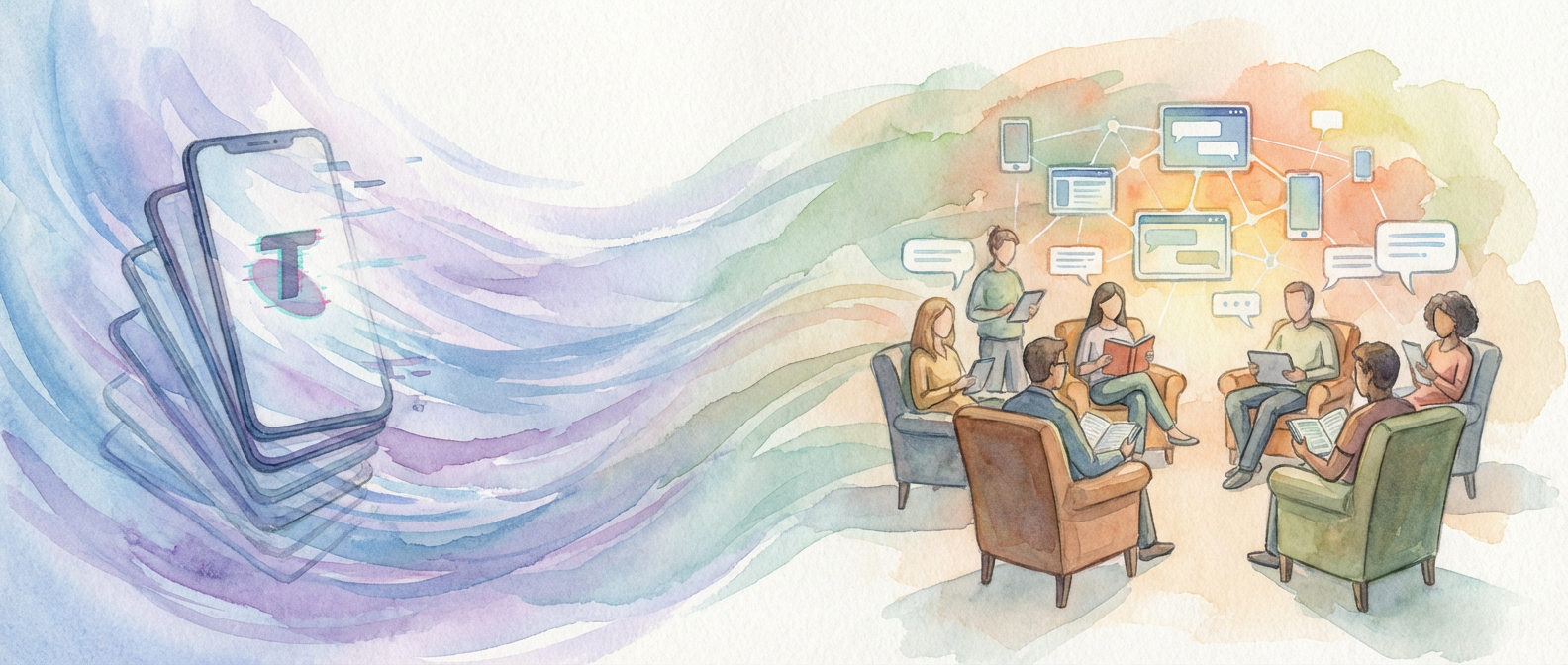
BookTok’s Quiet Extinction and the Rise of Discord’s Literary Underground
The Platform That Broke Its Own Algorithm
Remember when BookTok felt inevitable? Like it was going to be the thing that saved the publishing industry forever. Every coffee shop had someone with their phone propped up, reading a sad-girl fantasy to thousands of strangers who would then buy out the local Barnes and Noble within 48 hours. It was chaos and it worked, and for a moment there, it felt like the future of how we talk about books.
Except here’s what happened: the algorithm got too hungry. By 2023, BookTok’s #BookTok hashtag hit 300 billion views and basically maxed out. The platform became so saturated with book content that creators started chasing increasingly dramatic angles to cut through the noise. Suddenly it wasn’t enough to just love a book. You had to have a breakdown about it. You had to cry. You had to have a controversial take. The actual reading part started feeling optional. And then in 2025, something shifted. The Bookseller Digital Trends Coverage reported that new BookTok content creation dropped 31 percent. Not views. Creation. People just stopped making the videos.
The burnout was real, and it was mutual.
Where the Readers Actually Went
BookTok didn’t die. It just got really, really quiet. Meanwhile, something unexpected started building in the corners of the internet where most cultural trends go to be ignored: Discord servers dedicated to actually reading books together, slowly, in real time. The numbers tell the story. In 2025, Discord reported that book-focused servers grew by 44 percent. That’s not incremental growth. That’s people actively choosing a different way to experience reading culture. And the part that matters most: servers built around reading a book chapter by chapter, over weeks or months, overtook quick-recommendation servers in active membership for the first time. People were choosing patience over speed.
It’s a complete inversion of how we’ve been conditioned to think about online discovery. We live in the age of the hot take, the quick scroll, the instant gratification. But inside these Discord communities, thousands of readers are doing something almost radical: taking their time. Reading 50 pages a week and then spending hours in text channels talking about what those 50 pages actually meant. Arguing about character motivation in threads that run for days. Building relationships with other readers, not just collecting likes.
The people in these communities aren’t performance reading. They’re actually reading.
The Indie Bookstore Renaissance Nobody Saw Coming
Here’s where it gets interesting for the actual book industry. Independent bookstores started paying attention. Some of them began partnering with these Discord communities, organizing in-store events around the books being read together. Book clubs meeting in person, organized entirely through Discord. According to the American Booksellers Association Industry Reports, indie bookstores running Discord-connected events saw 27 percent higher foot traffic compared to stores running Instagram-only promotions. That’s a concrete number. That’s money.
The big publishers noticed too. Penguin Random House’s marketing team literally added Discord to their tracking systems. They’re now measuring what they call Discord-native word of mouth as an actual acquisition channel for their literary fiction titles. That’s the moment you know something has shifted. When the major gatekeepers start building infrastructure around a platform, it’s no longer a subculture. It’s a system.
What Slow Reading Actually Does
But here’s what matters most, and it’s not about metrics. A University of Michigan study from early 2026 found something that probably shouldn’t have been surprising but definitely was. Readers who were part of slow-paced online reading communities retained 40 percent more thematic content from the books they read. Not plot points. Themes. The actual meaning. They also reported three times higher personal meaning derived from their reading compared to people who primarily got their book recommendations from short-form video. Essentially, when you slow down and go deeper with a community instead of chasing viral moments, you actually get more out of the books.
That’s not a small thing. That’s the difference between consuming content and actually connecting with literature. Between knowing what book is popular and understanding why it matters to you personally.
The New Quiet Revolution
What’s happening right now in Discord book clubs isn’t flashy. There are no TikTok compilations, no BookTuber drama, no publishing house sponsorships. It’s just people choosing to read the same book at the same time, in the same digital space, building something sustainable because it’s not designed to go viral. It’s designed to go deep.
Culture writers are still talking about BookTok like it’s the story. But the real story is that readers got tired of performing and started just reading again. They found each other in spaces where algorithms couldn’t manipulate them, where growth wasn’t measured in views, where the goal was understanding rather than engagement metrics. Bookstores are thriving because of it. Publishers are tracking it. Universities are studying it.
If you’ve been feeling like something shifted in how we talk about books, you’re not imagining it. The revolution just happened quietly, on servers with names like “the cottage readers” and “chapter-a-week club.” Want to know where actual literary culture is living right now? Stop scrolling. Start listening in the Discord channels where people are actually talking about what they read. That’s where the story is.
Comments are Disabled